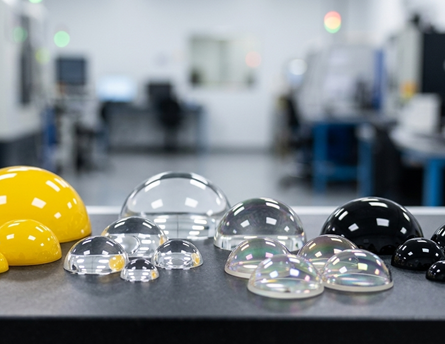
Have you ever wondered how deep-sea robots capture stunning, distortion-free video of the ocean floor, or how the highly sensitive sensors on an aircraft survive supersonic speeds without being blinded?
The secret lies in a seemingly simple, yet incredibly precise piece of engineering: the optical dome. Whether protecting a camera in the Mariana Trench or shielding infrared sensors on a high-speed jet, custom optical domes are the invisible shields that make modern exploration and defense possible.
What is an Optical Dome?
At its core, an optical dome is a hemispherical window. Unlike a standard optical lens, which is designed to intentionally focus or scatter light, an ideal optical dome consists of two perfectly parallel curved surfaces. Because the inner and outer curves match exactly, the dome acts as a protective boundary without altering the path of the light passing through it.
Think of it as a perfectly curved, highly engineered bubble made from glass, acrylic, sapphire, or other specialized optical materials.
The “Magic” Physics: Why Not Just Use Flat Glass?
If you’ve ever worn a flat scuba mask underwater, you’ve probably noticed that everything looks about 25% larger and closer than it actually is. This happens because water and air have different refractive indices, causing light to bend as it passes through the flat glass of your mask. The physics of this bending is governed by Snell’s Law (n1 sin(θ1) = n2 sin(θ2)).
Custom optical domes solve this problem brilliantly.
If you place a camera lens at the exact center of the dome’s curvature, every ray of light entering the lens hits the dome’s surface at exactly a 90-degree angle (perpendicular to the surface). When light hits a boundary head-on, it doesn’t bend.
Because the light isn’t refracted at the dome’s surface, the camera retains its true, ultra-wide field of view—which is crucial when tracking a wide area from the sky or capturing the vastness of the ocean.
4 Fascinating Applications of Optical Domes
- Underwater Photography & Cinematography: To get famous “split-shots” (half underwater, half above water) or to capture massive coral reefs with a wide-angle lens, photographers use large dome ports. A flat port would magnify the water half, ruining the image, but a dome port keeps both perspectives matching perfectly.
- Deep-Sea Submersibles (ROVs): The deep ocean is an incredibly hostile environment with crushing pressure. A spherical shape naturally distributes physical stress. By using thick glass or sapphire, ROVs protect fragile cameras from immense pressure while maintaining a crystal-clear, wide-angle view of the abyss.
- Aerospace & Defense: Missiles, drones, and advanced aircraft rely on infrared and radar sensors to navigate. These sensors are protected by specialized domes that are incredibly hard. They must withstand the heat and friction of Mach speeds while remaining perfectly transparent to specific wavelengths of light.
- Meteorology & Environmental Monitoring: Pyranometers, instruments used to measure solar radiation, sit outside 24/7. They use small glass domes to protect delicate internal sensors. The hemispherical shape allows the sensor to capture sunlight from a full 180 degrees while shedding rain and resisting wind.
Our Manufacturing Capabilities: Precision Custom Optical Domes
As a leading optical production company, we understand that off-the-shelf solutions rarely meet the rigorous demands of specialized industries. We specialize in the engineering and manufacturing of custom optical domes tailored to your exact environmental and optical requirements.
Our production facility is equipped to handle everything from rapid prototyping to high-volume manufacturing.
Materials We Work With
Different environments require different optical and structural properties. We manufacture domes using a variety of high-grade materials:
| Material | Key Properties | Ideal Applications |
| Sapphire | Extreme hardness, scratch resistance, high thermal conductivity, broad transmission (UV to IR). | Aerospace, defense, deep-sea submersibles, high-pressure environments. |
| Fused Silica / Quartz | Excellent thermal shock resistance, high UV transmission. | Lasers, UV monitoring, outdoor environmental sensors. |
| N-BK7 / Optical Glass | High clarity, cost-effective, excellent visible light transmission. | Commercial underwater photography, weather monitoring, architectural lighting. |
| Zinc Sulfide (ZnS) | Exceptional transmission in the infrared (IR) spectrum. | Thermal imaging, defense targeting systems, night vision applications. |
| Acrylic / Plastics | Lightweight, impact-resistant, easily molded for very large domes. | Shallow-water submersibles, commercial camera housings, display enclosures. |
Advanced Customizations & Coatings
Manufacturing the dome is only the first step. We offer in-house finishing to ensure your custom optical domes perform flawlessly:
- Anti-Reflective (AR) Coatings: We apply broadband or wavelength-specific AR coatings to minimize internal reflections and maximize light transmission.
- Custom Thickness & Radii: We engineer domes with specific inner and outer radii to withstand calculated pressure loads without compromising optical integrity.
- Precision Polishing: Our polishing techniques ensure minimal surface roughness, preventing distortion and scattering in high-resolution imaging applications.
- Protective Hard Coatings: For environments prone to sand, salt, or debris, we offer diamond-like carbon (DLC) or other hard coatings for added durability.
Conclusion
From the crushing depths of the ocean to the extreme friction of the upper atmosphere, custom optical domes are the ultimate meeting point of structural engineering and optics. By relying on flawless geometry and advanced materials, they allow our most vital instruments to see clearly into the most unforgiving environments on—and off—our planet.
Looking for a manufacturing partner for your next project? Contact our engineering team today at MostOptics to discuss your specific requirements for custom optical domes.